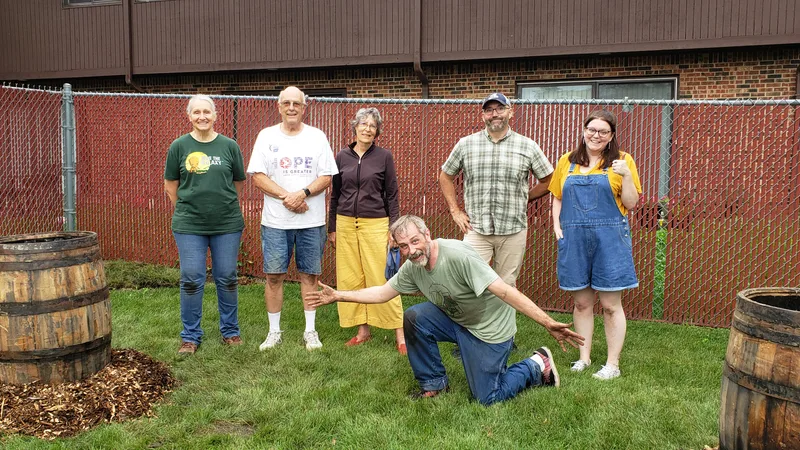
The pawpaws at Glidden Homestead were planted on July 7, 2024. The barrel planting method is based on methods described in James A. Little’s “A Treatise on the Pawpaw” from 1905, who would have been a contemporary of Joseph Glidden’s, though there is no indication they would have met.
From “A Treatise on the Pawpaw”:
“The pawpaw tree by nature is an undergrowth and necessarily must be shaded when it first comes up. My plan which has been entirely successful is to make a hill like a watermelon hill and plant about five seeds two or three inches deep in the fall. In part for protection but mainly for shading the plants when they come up I place a barrel with both heads out over the hill and let it remain for a year or two. After that the barrel may be removed and the plants will bear the sun.”
Shawn Beck, Pawpaw Foundation Secretary and Founder, facilitated the donation of retired barrels used for the planting from local distillery Whiskey Acres. With help from Matt Keys, the ends were removed and they were used to shelter the young pawpaws in this fairly full sun location - the hollow barrels are not used as planter containers but are rather acting like protective tree tubes. The barrels shade the small trees from full sun, protect their trunks, and aide in retaining soil moisture - all the trees are planted in ground within the protective barrels. The three barrels were originally planted with a mix of one grafted seedling, young select seedlings, and select seeds.
The western-most barrel was planted with a seedling from Papa Pawpaw’s Plants in Rock Island, owned and operated by Chris Rice. It is an open-pollinated seedling from his two original cultivar trees, either Shenandoah or Atwood, which were at the time his only flowering trees. It is the tallest seedling planted in the Northwest Quandrant. An open-pollinated seedling from Austin Cliffe’s TG-Winner (possibly the Corwin Davis selection “Toll-Gate”) branch is in the North East Quadrant. Fruit from this branch has placed and won at the Ohio Pawpaw Festival Best Tasting Pawpaw Competition. As of 2026, these are the two largest trees in that spot. Seeds from a mixture of other locales were direct-sown - FG+: Open pollinated good quality fruit from Funk’s Grove Maple Sirup, BG: Blumen Gardens oldest trees, and VP-1: the surviving tree at 520 South Sixth Street in DeKalb. A number of these seedlings came up but were dwarfed by the aforementioned larger seedlings. Some of these smaller seedlings were moved by Austin in 2025 to the Southernmost barrel where planted seeds failed to thrive.
The Northeast corner barrel was planted with a seedling grafted with Albi-R. Albi-R is the name assigned by Austin to this advanced selection, which is the eastern pawpaw tree at Albion College in Michigan south of Olen Hall. Albi-L is the name he assigned to the pollinator, the western tree. Albion Sunrise for Albi-R and Albion Sunset for Albi-L are other names that are clearer indications of plantings. This pair of mature pawpaw trees were moved to Albion College circa 2000 from the Toll-Gate Gardens and Nursery using a 9’ hole digging trailer by a professor whose name is unknown to Austin, as all of this information came anecdotally from Larry Sibley, Corwin Davis’ son-in-law, both of whom are now deceased. The grafted seedling is the tallest tree in the Northeast quadrant of this barrel. Seeds from Neal Peterson’s Wabash cultivar originating from George Hale’s Orchard were sown in the northwest quadrant, seeds from Jerry Lehman or Doug Fell’s orchard in the southwest quadrant, and VP3 - Austin Cliffe’s seedling tree in from DeKalb, in the southeast quadrant.
The southern-most barrel seedlings did not thrive, so seedlings from the other barrels were thinned and transplanted to it in 2025. In 2026, a large seedling from DeKalb County’s 250 Trees for Tomorrow Program was planted in this barrel by Austin. This tree was sourced from Midwest Ground Covers, but bore a tag from Forrest Keeling Nursery in Missouri, which is known for grafted pawpaws - perhaps it is a seedling of a cultivar tree. It is in the north slot and the largest tree in this barrel.
We plan to remove the barrels in early 2027 and replace them with staked tree cages that bare a superficial resemblance to The Winner barbed wire, perhaps with some shade cloth.