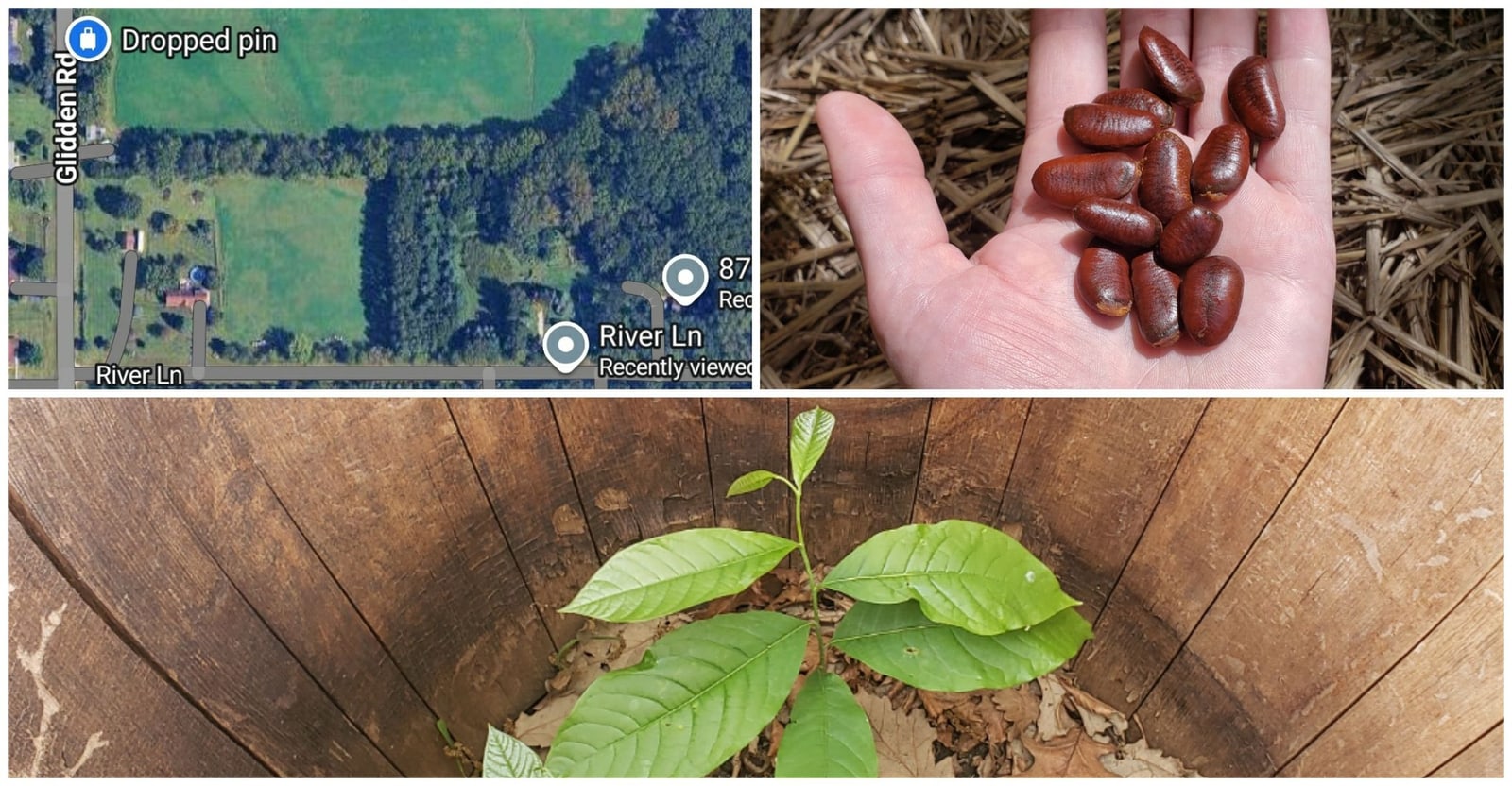
Come spend the morning putting pawpaw seeds and seedlings in the ground at a private property in Kingston, Illinois. Open to all — no experience needed.
Parking and directions: use the pull-off just north of 32932 Glidden Rd and park. Walk east to the far end of the adjoining alfalfa field — we'll meet you there. Bring long pants and work clothes, sun protection, your favorite work gloves, and water. Tools are provided.
We'll be planting pawpaw seedlings using the barrel method described by James A. Little in his 1905 pawpaw pamphlet — and putting in a good number of seeds as well. Pawpaws are native understory trees and cannot survive even one day's full sun as seedlings. A barrel with both heads removed, placed over the planting hill, provides dappled shade for the first year or two.
Austin will be on hand to walk through the barrel method in characteristically thorough detail. If you're interested in taking home a seedling, not just seeds, reach out to Austin before the event to let him know.
On the barrel method: pawpaws germinate in the shade of a forest canopy, and young seedlings are essentially defenseless against direct sun — even a single hot afternoon can kill a first-year plant. Plant seeds in a mounded hill, then set a barrel with both heads removed over the hill like a chimney. The barrel blocks harsh direct sun while still allowing light, air, and rain through. It stays in place for the first year or two while the seedling builds its root system underground; once the plant can handle open exposure, the barrel comes off.
We're using this method because it works, and because James A. Little documented it in detail in 1905. He wrote: Make a hill like a watermelon hill and plant about five seeds two or three inches deep in the fall. In part for protection but mainly for shading the plants when they come up I place a barrel with both heads out over the hill and let it remain for a year or two. The pawpaw tree is by nature an undergrowth and necessarily must be shaded when it first comes up.
Can't make June 13? See what else is coming up.